
So. Doorknobs.
I've been promising Francine that I will write this entry for a while now, but there have been a few road blocks for me. Not what, I am sure, you would think of as the 'normal' roadblocks to writing an entry about doorknobs- lack of inspiration, lack of passion for my topic, a staggering lack of depth or conflict to really sink my teeth into. What, I am sure you are wondering, am I supposed to write about, exactly? Weather to install a keyed entrance knob or a privacy knob on your bathroom door (I would suggest a privacy knob, btw)?
No, in all honesty, it isn’t a lack of anything that has kept this entry on the back burner. Rather, it is the shocking (physically as well as mentally, as you will see later) overabundance of topics that has left me stumped for so long. The sheer number of metaphors and analogies that can be drawn from the common doorknob alone is mind boggling, not to mention the unique position I hold as possibly the only person who ever had somewhat of a love affair with the doorknobs in my house as a child.
Yes, that's right, not only did I invent fears with the explicit purpose of self-behavior modification as a child, I also spent hours debating the relative benefits and downfalls of doorknobs. Hours.
I was very bored as a child.
However, this entry is not about my childhood quirks, at least, not primarily. It is about doorknobs. So, let us begin.
I have split this entry into several sections with the hope that it will be easier to digest in pieces rather than as a whole. I am told I often loose my readers, and while I do find it amusing when you call me and say little more than 'Huh?' I am trying to improve. I apologize that my phrasing has not changed much, if at all, but I have been writing this way for most of my life, and I have too much fun reading what I wrote and too little self-control to change it now. You will have to excuse me.
Now, onto the fun.
To fully appreciate the delicate intricacies of this entry, first you must understand a few things about doorknobs. Everyone knows what a doorknob is- well, at least everyone in a modernized English speaking country, I assume (for you Czech speaking readers I am talking about knoflík na dveřích, or dveřní klika, if you prefer)- but how many people actually understand how they work? Or even, exactly what one's options are in selecting a doorknob. On your next trip to your local hardware store, take a stroll through the "Locks and knobs" section. It's a long isle. Trust me.
Though, I do not suggest that you actually ask in-depth questions of the clerk about your doorknob choices. Not many people are "Dear lord, why do the crazies always find me"-glare-proof, as I am.
As with any new material, a solid understand of the origins and history of your topic is a required first step. And so, I present:
Once upon a time (exact date unknown) someone (exact person(s) unknown) wanted to keep something (exact intruder unknown, but believed to most likely be large rodents or wife stealing bastards) out of his abode (exact building specifications unknown). Said person(s) installed some sort of 'door-stopping device' onto the outermost entryway to said abode. It was one small step for said person(s) (and an even smaller step for said wife stealing bastards) but one giant leap for person-kind.
Alright, that's not exactly true. It wasn't that big of a leap. We're not talking about fire or the wheel or slave trading here or anything- just a simple doorknob.
In all honesty, no one really knows the exact who, when, where or why of doorknobs. It is known that many early roman homes had doorknobs at least on the outer passageways. Richer homes were lucky enough to have them on the inside as well. Other forms of handles are seen even before the Bronze Age in regions such as the UK and Egypt. It's rather impressive, really.
It is also known that in 1878, Osbourn Dorsey, an African American inventor was issued the first patent for his 'door holding device'. Later in the 19th century Washington Martin (also African-American) was granted a patent for the modern lock. Today, the patents for the doorknob and adjustable latch assembly (the internal mechanism for a standard privacy knob) belong to Wen-Pin Wu.
Now that we know a bit (and I mean just a tiny little bit- this was one of the most uninformative 'history of the art' sections I believe I have ever written, but really, you try to look up info on the doorknob) about where our doorknobs came from, we need to understand where they stand now.
There are four types of doorknobs available in the modern market. I was surprised by this, as it seemed to me (after my lengthy visit to Lowe's "Locks and Knobs" Isle) that there ought to many, many more types than four. However, after a bit of careful consideration, I did manage to find appropriate categorization for all the doorknobs I found in one of these four many groups. The groups are separated by functionality alone. The "Dumby Knob", the "Passage Knob", the "Privacy Knob", and the "Keyed Entrance Knob". They are all rather self-explanatory if you ask me, but here's some quick definitions for you:
Dumby Knob: Not a functioning doorknob, used generally for aesthetics only, often used when two doors close into each other, and only one door is opened and closed regularly. Doors sporting these sorts of knobs rarely, if ever, close completely or evenly and have been used in numerous psychological studies of the reactions of persons with OCD in an uncontrollable world.
Passage Knob: Does not lock on either side of door, most often used in places such as closets. Unsolicited advice: if upon your first visit to a new potential partner's home you notice an overabundance of these knobs, leave while you still have a chance. It can be a depressing but 99.9% accurate indication of a person with NO BOUNDARIES and a tendency to cling at the most inappropriate of times. What sort of person doesn't want privacy knobs on the bathroom door?
Privacy Knob: Can be locked and unlocked only from the inside of the knob, convenient for bathrooms and bedrooms. Can be installed backwards on closet doors as set up for practical jokes or impromptu blind dates.
Keyed Entrance Knob: Can only be unlocked from the outside with a key, best when used on out-facing doors or primary entrances in sectioned building (office or apartment buildings). Unsolicited advice: if upon your first visit to a new potential partner's home you notice an overabundance of these knobs, leave while you still have a chance.
The actual assembly of a doorknob is not generally common knowledge. Not many people know why or how their doorknobs work, simply that they do, and that without them houses would be a lot less secure and easy to navigate. It's quite simple, really. There are six main parts to a standard doorknob: the inner knob, the mounting plate, the latch assembly, the latch, the cylinder, and the outer knob.
The inner and outer knobs are just what they sound like, the actual knobs themselves that can be found on either side of the door. The mounting plate is, of course, the piece that fastens the knob to the door. Dumby knobs usually consist only of these three parts, and even in many cases do not have both an inner and outer knob.
The latch assembly is the inner workings of the knob. It is a small series of gears, wheels and springs that connect the turning of the knob, or the depressing of a handle or some other motion, to the retraction of the latch. The latch is, amazingly, the post that locks the door into place. These two parts are found on all passage, privacy and keyed entrance knobs. The cylinder is only found on keyed entry doors, as it is the actual key hole.
The difference between the latch assemblies of a locking door and a passage door lies in a simple trip switch that slots into place when the knob is locked that disconnects the knob from the latch assembly. Once unlocked, the trip switch is either raised or moved aside, and the connection reestablished when the knob is turned again. This is why you cannot unlock a doorknob while the knob is turned; the trip switch becomes lodged between the first gear on the knob and the wheel in the latch assembly and cannot move out of the way to return functionality to the knob.
Doorknobs have their specific purposes, obviously, but that has never stopped humanity from adding to the list. Gaining a basic understanding of what a doorknob truly is, how it functions, where it is derived from, and how it is put to use, is all fine and dandy, but humanity can not stop there. We must find unconventional uses for conventional items. We must cram greater meaning into even the most shallow and mundane of words. We must twist things about until there is little-to-no trace of what they once were and then call ourselves linguistic, cultural and revolutionary geniuses for our unmatched ability to destroy the beauty of the spoken word and the simplicity of mechanics.
It never ceases to amaze me the lengths that human culture will go to use common words in new and inventive ways. Perhaps the most striking aspect of how humanity dissects its own languages lies in the fact that no word is safe. How often do you say the word 'doorknob'? Once a day? Once a week? I would dare to say that most people actually say the word doorknob less than once a month. And yet, it has still become the target of countless crimes against language.
The list of common metaphors that involve doorknobs is nearly never-ending. From "Licking frozen doorknobs" for lying on the spur of the moment, to the comparative metaphor of "Slicker than hot snot on a glass doorknob", from the sarcastic "clever as a doorknob", to the blatantly vulgar "polishing his doorknob", people have found countless ways to bastardize even this most commonplace of objects through supposedly clever turn of phrase. Here are a few of my favorite doorknob metaphors, in addition to the four above:
They make more turns than a doorknob. (moody/slutty)
They have the IQ of a doorknob. (dumb)
As dull as a doorknob. (boring/dumb)
All over it as a fist on a doorknob. (obsessed/stalking)
As useful as a door without a knob. (useless)
Dead as a doorknob. (dead)
Don't let the doorknob hit you in the ass on the way out. (incorrect phrasing of a saying meaning 'good riddance'- I love stupid people)
Doorknobs have also been used in more lengthy analogies, most often in connection to a door metaphor. For example, a rough translation from a Chinese proverb: "A teacher will show you the door, they will even turn the knob, but you must enter by yourself". Or the rather pessimistic additions to a common inspirational quote: "The door to happiness opens towards you... and there is no knob to pull." And the list continues once again, but rather than focusing on how often the doorknob is used in metaphors, I would like to focus on how often they are ignored.
You can learn just as much about a culture from studying what is missing from their metaphors as you can from dissecting what is there. The doorknob, for example, is continuously left out of door analogies. The author will make mention of the door, the lock, even the jam, before remembering to put in the all important knob. As illustrated in our last quote, what good does a door with no knob do for you anyway? Ralph Waldo Emerson sought to inspire the world with "Every wall is a door... and you have the key!" but what of those humans smart enough to think ahead? Having the key is a great advantage, but we're still going to need some way to open the door after it's been unlocked. Next time you stumble across a door metaphor, look for the knob. I'm afraid that the chances are that 99% of the time, that metaphor will have to remain closed to you.
What, exactly, does it say about humanity at large, that we would forget such a crucial element on such a regular basis? Are we such a disconnected culture that we cannot keep in mind all the aspects of our own metaphors? Have we grown so lazy that we can not be bothered to mark one of the most important fixtures in our homes?
The American populace has been marked as especially complacent, choosing to over look the small but crucial elements to our own lives, religions, government and social structures. The fact that we routinely take for advantage the fact that we have doorknobs speaks to that idea on some level. Granted, it is not the most telling of observations, still it does say something about those who can choose to forget something that provides a convenience we would loath to be without until we are forced to.
However, in this case, it is not only the sinister Americans that are guilty. Humanity's willingness to over look the little, consistent things is clearly illustrated through doorknobs. In a much broader analogy- one I am sure will be called ludicrous by at least one person after having posted this- doorknobs represent the general mindset of 'make it, break it, replace it'. The squeaky wheel may get the oil, but the loose doorknob is ignored until it breaks and then it is simply replaced with a shiny new one.
We, as a whole, strive to create the better, faster, more convenient, and then through lack of care and attention we destroy that which we created. The worst part is that rather than learning from our mistakes, we simply start the process over again; make, break, replace. This destructive pattern has bled through the minute and mostly harmless into nearly all aspects of human life.
Take the creation of the automobile and the current worries over global warming versus the current oil crisis. We create an element of comfort for ourselves, never thinking of the eventual impact on the world in which we live. We have suspected for years that car exhaust is extremely detrimental to the environment, and yet we did nothing to combat that issue because it wasn't convenient. Now, when it has become more expensive to run a car off these environment destroying fossil fuels, when we see right before our eyes the possibility of not having the convenience of simply looking the other way any longer, we begin our search for a replacement in earnest. Not for the greater good of our world, not to fix a mistake, simply to prevent having to give up a convenience we have come to rely on. Make, break, replace.
Yes, this mindset is exemplified well by something as simple as the doorknob. Mark my words, five hundred years from now, some brilliant Archeologist will stumble across a landfill brimming with doorknobs and marvel at the excess, wastefulness and self-centered nature of our society.
While it is true that doorknobs can easily be used to make harsh social commentary about human nature, it is also true that doorknobs can easily express a softer, more playful side of humanity. From intricate artistic knob designs, to silly childhood games, doorknobs bring to light a more whimsical side of man, if you know where to look.
First, Doorknobs. Not the object but the game. Most popular in Great Britian and parts of Australia, this game is only one of the many variations on the 'safety' theme, much like "Punch Buggies" or "Puddidle-Budinkle". When one child breaks wind, he or she must call out "Safety" before someone else calls out "Doorknobs". If they don’t make it in time the other children present can- and will- give them 'free beats' until they touch a doorknob. If someone seems to have called safety for no reason, they automatically get hit twice. It's just the principal of the matter really: you can't waste a perfectly good safety like that and expect to get away with it. And really, if it was that silent and that scentless, you should have just kept quiet.
This playful- and violent- association follows many children through adolescence and into adulthood with such things as the 'electric-shock-doorknob' prank. A similar, if more painful, idea is used in Home Alone when Kevin McAllister attaches a red hot iron to the inside of a metal doorknob to deter burglars, and again in Home Alone 2: Lost in NY, when Kevin connects a doorknob to a nail gun trigger. One of the most utilized symbols of the entire Home Alone Series is the M from the McAllister's monogrammed doorknob permanently burned into Harry's palm. It is just one example of how society has been able to express its lighter side through doorknobs.
Doorknobs are used again and again through movies and even plays to bring a greater completeness to a set. From the McAllister's monogrammed doorknob, to the animated 'butler'knob of Beauty and the Beast, the simple elegance of the doorknobs scattered through the house of The Others, to the complex rig attached to the doorknob in The Goonies, these everyday objects have been extrapolated upon in nearly every creative art available. With such things as Bob Henley's Wren on Doorknob print and the Perthshire doorknob paperweight available from Randall Antiques & Fine Art even doorknobs have been integrated into the human experience of art and creativity.
As a matter of fact, doorknobs themselves have become a popular base for artistic works. Many people, in many different countries throughout the world spend their lives designing and creating works of art from the common doorknob. With a little time and effort you can easily find groups such as the Doorknob Art Photo Share on Flicker, the Handle Guild for makers of fine door handles, and the "Antique Doorknob Collectors of America". And with a little time and effort, those groups will even find you! Architectural Classics, a blog that "brings original old lighting and door hardware out of the realms of Sunday visits to the auctions," left a comment on this blog, marveling at the fact that someone else in the world is blogging about doorknobs. Their most recent post, The Locomotive Knob, provides their readers with a beautiful picture of a train-stamped knob, and a little food for thought on modern design options. It's really a fun site.
However, it's not only online that you will find other doorknob-enthusiasts. The City Museum here in St. Louis recently had a Doorknob Exhibit, displaying some of the oldest, most artistic, or most unique doorknobs found through out the city. It was amazing to see just what exactly a creative mind can do with a simple doorknob. Here are a few of my favorite examples of "Doorknob Art":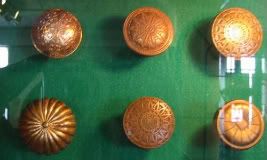
Antique doorknobs at St. Louis City Museum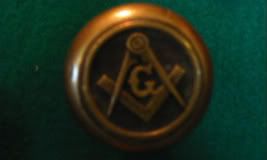
Masonic doorknob at City Museum
Libyan Doorknob
HandKnob
Escher's Glass Doorknob
Asland Doorknob at C. S. Lewis' childhood church
Doorknob designed by Klaus Voorman for George Harrison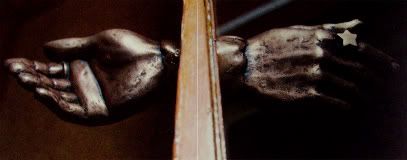
Doorknob designed by Klaus Voorman for Ringo Star
Most people never even notice the doorknobs in their homes. I am not most people. I noticed. More than just noticing, I went through a period of about three months in which I spent a large amount of my time contemplating my doorknobs.
The doorknobs in my apartment were very traditional glass knobs from the Victorian age, original to the apartment. They were one of the few remaining original aspects of the building, other than the porcelain bathroom fixtures that never worked exactly right and rickety windows that never kept out the cold. They were cut to fit your hand, no matter how you placed it on the knob, and the interior created an intricate prism that would catch any available light, even on the darkest of nights. I was unable to find a picture that really did these beauties justice, but the following is basically what I am talking about: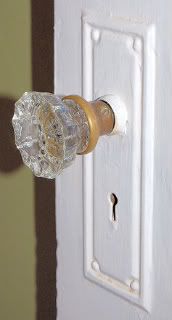
I was always a strange child. Bookish and reserved, my mind constant swam through the abstract, pulling strands of disconnected thoughts into a semblance of order that would wrap about anyone else and pull them into the darkness of complete confusion. Alright, I admit, strange may be the right word for it. Scary might seem a bit more accurate. I had a tendency to spout off the most random of observations that would either have the adults around me boggling at the maturity of my mind, or boggling at the complete disconnect between a child's mind and reality. Other than that, I didn't speak much. As I said, bookish and reserved.
Never was I more reserved than when I was 11, however. I had just entered middle school, my stash of books was depleted, and my bus money non-existent. I got my first job that year, and because of the nature of it, I spent most of my 'off-time' reveling in the fact that I could simply keep to myself and think. Unfortunately, there wasn't mush available to think about.
Then I noticed the doorknobs.
They were rather startling at first. I had lived in this apartment for more than five years and I had never actually seen the doorknobs. I couldn't imagine how I had missed them. Even the slightest bit of light would catch and glint off them, bouncing through the middle before span out across the floor of wall in a prism of color. Each was unique, despite all having the same design. One was chipped on one side- I would compulsively turn this one until the chip was dead center on top. Eventually I had to take the knob off the door and turn it around so that it would stay in what I had deemed the correct position. One had a smear of caulk just under the curve of one of the flutes- this had to always be on the bottom, so as not to obstruct my view of the doorknob in all its glory. One rattled while another didn't move at all. All of them were entrancing.
How had I not noticed them before? Was it just that I had been that unobservant, that wrapped up in my own life and mind that I would miss such a treasure right in front of my face? Needless to say I didn't much like what that idea said about the type of person I must have been. And, never one to simply roll over an accept the negative, I decided to give myself a way out. I created a theory which would account for both my not noticing the knobs before and for the strange way they seemed to capture both light and my mind.
The theory stated that the doorknobs weren't actually there before- or at least, not these knobs. No, these knobs had been implanted, replacing the simple, ordinary knobs that used to grace our doors, by some evil force- an evil force intent on distracting those in the immediate area. They used the doorknobs to in trance my attention first, knowing that I would be the most observant person in my household and most likely to uncover any dastardly deeds going on about. Then they made other changes, adding the almost silver-shiny dust about the house that my mother absolutely could not simply overlook, speckling the walls with uneven spackle that my brother would attack with sandpaper and a vigor we hadn't seen from him in years.
They were trying to distract us from something, these strange evil beings with their evil doorknobs and dust, that much was obvious, but from what? Why, the inter-dimensional portal in my bathroom, of course. Yes, in the bathroom. Just between the sink and the mirror. How, you ask, did I discover this inter-dimensional portal in my bathroom? The Doorknobs (yes by this point they had acquired capital status).
If you lined up the doors in my house just right, at exactly 9:37am, during the month of March, the sun would come in through the East facing windows, bounce around each of the doorknobs to reach the other side of the house in a piercing stream of light. Just between the bathroom sink and mirror, in a spot that was ALWAYS dusty, and suspiciously devoid of spackle.
I watched that exact spot every morning for three months, intent that what ever demons may be on the other side of that potential dimensional rift stay properly on their side. Eventually, I gave up the pursuit and slapped a piece of duct tape over the spot and called it fixed. Duct tape fixes everything. Not to mention that duct tape is shiny and bounced the light back off the wall and into the doorknob and made the bathroom glow.
Even after saving the world with duct tape from evil doorknob demons when I was 11- beat that Batman- I didn’t loose my fascination with the doorknobs in my apartment. Rather, I focused more on the aesthetic beauty of them, marveling at how they looked in every light, and even with out any. I would color Saran Wrap with sharpies, pull it over a flashlight and see what colored light looked like against my blue walls both before and after passing through the doorknobs. I covered one of the knobs with clear acrylic primer and then painted it with water colors to make it look like stained glass. I pulled one knob from its base and shoved a small piece of colored paper between the glass and metal to make what looked to me like a snow globe with no glitter. I would switch the small glass handles from our cabinets with the passage knobs to see what a mini-doorknob would look like on a big door.
Eventually, my on going love affair with the doorknobs abated, though never completely. For a short while I developed a fear of doorknobs a kin to A Series of Unfortunate Events' Aunt Josephine's paranoia. I was convinced that if the sun were allowed to shine on a doorknob too long it would shatter and I would be permanently disfigured from the flying pieces of melted glass. And even though I was older, understood that my own theories were often nothing more than the ramblings of an over active imagine and an over educated and slightly warped mind, when we moved, I took booth doorknobs off the bathroom doors, just to be on the safe side.
I still have them somewhere, in with the rest of my things from my childhood. They were the only knobs in the apartment that I had not altered in some way. Last time I saw them, I was still awed by their simple beauty.
And part of my mind was still struck by the great dangers and evils they could be hiding.
How's that for a Doorknob entry? I think I covered everything: history, mechanics, literary use, social commentary, cultural importance, and personal views.
Who knew there was so much to a doorknob?
I did.
Tuesday, June 17, 2008
Handels, levers, and pommels.


Subscribe to:
Post Comments (Atom)


4 comments:
WOOOOOW!!! I thought we were the only people on this planet mad enough to blog about door knobs ;) Well done!
Wow! How did I not find your blog when I was looking for doorknob sites? I'm going to have to go back and edit my post now to add you guys in. Thank goodness for friends who demand blog entries on random topics!
wooooooooooo!!!!!!!!!!!!!!!!!11 i
<3 door knobs!!!!!
That's great Swanky, thanks! Be sure we will mention your post on our blog too. It would just be unfair not to share it with other 'doorknob-lovers' out there ;)
Post a Comment